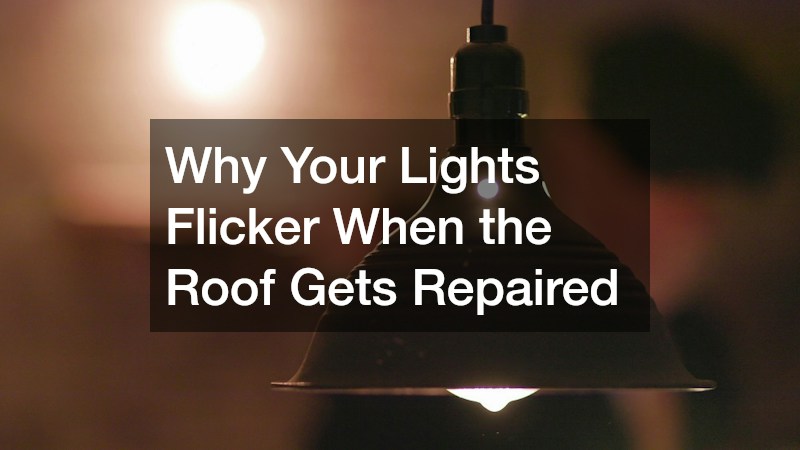
Why Your Lights Flicker When the Roof Gets Repaired
You’re halfway through a roof repair project when the lights in your living room start to flicker, and suddenly you’re wondering if something has gone seriously wrong. The good news is that this is a fairly common occurrence, and in most cases there’s a clear, fixable reason behind it. Understanding what’s actually happening behind your walls and above your ceiling can help you tell the difference between a minor nuisance and a real safety concern. This guide breaks down the most likely causes so you can approach the situation with confidence instead of panic.
Shared Attic Space Between Wiring and Roofing Work
Most homes route electrical wiring through the attic, often stapled along rafters or threaded through joists that sit just beneath the roof deck. When crews are pulling up shingles, replacing underlayment, or walking across the structure, vibrations travel directly into that shared space. These vibrations can cause loose connections at light fixtures, switches, or junction boxes to momentarily lose contact, which shows up as a flicker. It’s a mechanical issue rather than an electrical failure, but it still reveals that a connection somewhere wasn’t fully secure to begin with.
The severity of the flickering often depends on how old the wiring is and how it was originally installed. Newer homes with wiring secured according to current code tend to handle this disturbance without much issue. Older homes, especially those with wiring that has shifted or loosened over the years, are far more likely to show visible flickering during this kind of activity.
Temporary Power Interruptions During Structural Access
Some roof repairs require temporary access points that can affect the main electrical service drop, especially if the service line runs close to or attaches near the roofline. If a crew needs to work near where the power line connects to your house, they may coordinate a brief disconnection or experience accidental contact that causes a momentary dip in voltage. This typically results in a quick flicker rather than a full outage, since power is usually restored within seconds.
This is one of the few scenarios where professional coordination between roofing contractors and your utility provider really matters. Reputable contractors will flag if the service mast or weatherhead is anywhere near the work area and take precautions before starting. If you know ahead of time that your meter or service line sits close to the roof edge, it’s worth asking about this during the project walkthrough so there are no surprises once work begins.
Loose Connections at the Electrical Panel
Sometimes the flicker has nothing to do with the roof itself and everything to do with a connection issue inside your panel that was already borderline. Vibration from hammering, equipment movement, or even foot traffic on the roof can travel through the home’s frame and panel mounting, just enough to disturb a marginal connection. This is more likely in homes where the panel hasn’t been inspected in several years or where DIY work has been done in the past.
If flickering continues well after the roofing crew leaves for the day, it’s worth paying closer attention to this possibility. A flickering light that only happens during roof activity is probably mechanical, but one that persists afterward points toward a connection problem that needs attention on its own.
- Flickering limited to rooms directly under the work area often points to attic wiring disturbance
- Flickering throughout the whole house suggests a panel or service-level issue
- Lights that dim and brighten rather than flicker on and off may signal a voltage fluctuation
- Breakers tripping alongside flickering is a sign that deserves prompt attention
- Flickering that starts after the roofers leave, rather than during work, is the clearest red flag
Solar Panel and Roof-Mounted Equipment Disruption
Homes with solar panels, roof-mounted antennas, or satellite equipment have an extra layer of wiring that roofing crews need to work around carefully. Disconnecting or temporarily moving solar conduit during a repair can cause fluctuations in how your system feeds power back into the home, which can show up as flickering in connected circuits. Even a brief disruption to an inverter connection can cause noticeable changes in how lights behave until the system is reconnected and stabilized.
If your home has solar panels, it’s worth confirming before the project starts how the roofing team plans to handle that equipment. Most experienced crews will loop in a licensed electrician to manage disconnection and reconnection safely, since this isn’t typically something a roofer is trained to handle alone. Skipping this step is one of the more common reasons homeowners see unexpected electrical symptoms during a solar-equipped roof replacement.
When to Call in a Licensed Professional

Not every flicker requires a service call, but there are situations where bringing in outside expertise is the smart move rather than waiting it out. If flickering continues for more than a day after roofing work wraps up, or if you notice burning smells, warm outlets, or buzzing sounds, those are signs that go beyond simple vibration. At that point, calling a provider of electrical services to inspect your panel, wiring, and connections is a reasonable precaution rather than an overreaction.
It also helps to keep communication open between both trades if your project involves any electrical components near the roofline. A quick conversation before work begins, where the roofing crew confirms what’s near the work area and flags anything unusual, can prevent most of these issues before they start. Taking a few minutes upfront is far easier than troubleshooting a mystery flicker after the fact.
- Flickering that lasts more than 24 hours after project completion
- Any burning odor, sparking, or visible scorch marks near outlets or the panel
- Warm or buzzing outlets and switches
- Repeated breaker trips during or after the roofing project
- Flickering that spreads to areas of the house far from the roof work zone
Flickering lights during a roof repair are usually explained by simple vibration or a brief, temporary power interruption, and most cases resolve on their own once the project wraps up. Still, it’s worth paying attention to how long the flickering lasts and whether it comes with any other warning signs like warm outlets or unusual odors. If something feels off once the work is finished, trust that instinct and get a professional opinion rather than assuming it will sort itself out. A little attention now can save you from a bigger, more costly problem down the road.